Part I · Chapter 1
The Art of Seeing
1,248 words
There's a book by Aldous Huxley called The Art of Seeing. It doesn't get talked about nearly enough.
Huxley wrote it in 1942, after his eyesight had deteriorated so severely that he was nearly blind. He'd tried everything — doctors, specialists, the usual routes — and then, almost by accident, he found a method that worked. Not surgery. Not medication. A practice. A set of exercises for retraining the way his eyes and mind worked together. His vision improved dramatically. And in the process, he discovered something that changed how he thought about perception itself.
The premise of the book — that seeing is something you can develop, refine, practice — sounds obvious until you actually sit with it. We assume seeing is passive. Something that just happens. You open your eyes and the world comes in. But Huxley's argument, and my own experience over years of photography, is that this is wrong. Seeing is a skill. And like any skill, most people never develop it past the most basic level.
I picked up a camera seriously around the age of 16. I didn’t really know what I was doing — only that I was drawn to it.
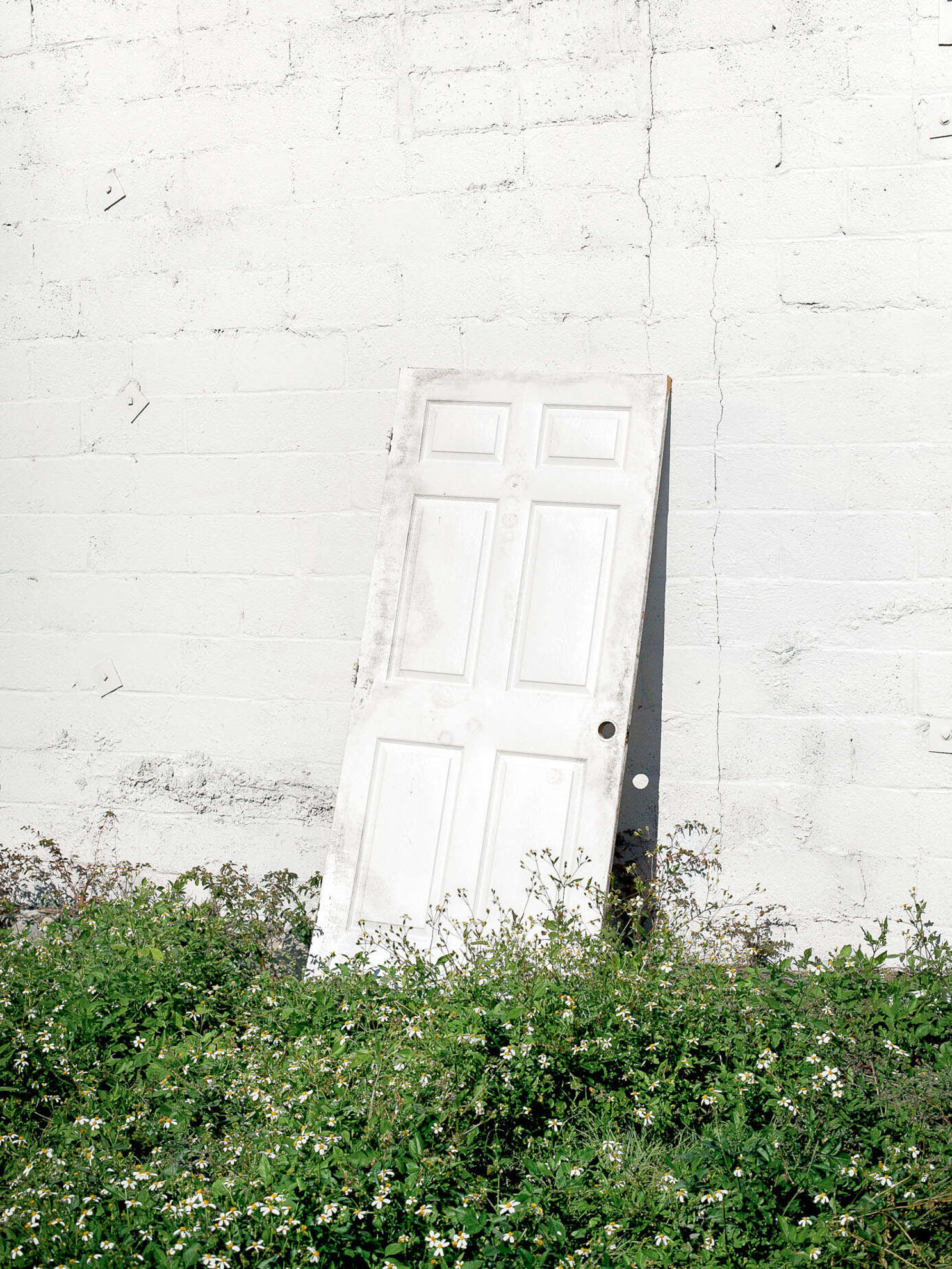
The way certain light would fall across a wall. The way a stranger moved through a crowd. The way a white door leaning against a white wall in an empty field could somehow feel completely present.
I didn't have language for any of it then. I just kept shooting.
What I didn't realize at the time was that the camera was doing something to me. Not just recording images — changing the way I moved through the world. I started noticing things I'd walked past a hundred times without registering. A shadow. A reflection. The geometry of a fire escape. The expression on someone's face in the half-second before they noticed me.
The camera had given me a reason to pay attention.
That's the thing nobody tells you when you start. You think you're learning photography. You're actually learning to see.
The difference between looking and seeing is the quality of attention — both outward and inward. Looking is how most people move through most of their days: efficient, scanning, processing. Seeing is something else. It requires a particular kind of curiosity — the kind that can stop in front of something ordinary and ask: what is actually happening here?
For a photographer, there's usually a feeling in mind — not always a finished image, but a sense of what you're reaching toward. A quality of light. A mood. A tension. That intention changes how you move. You slow down. You look twice. You notice the thing behind the thing.
At NOICE, the genre we've built everything around — minimal comic-play — is really just a name for witty seeing. Noticing the absurd, the playful, the slightly off-kilter in everyday life. The things most people pass off as uninteresting. Those with a higher degree of curiosity see these things as beautiful and unique. The manifesto we wrote for it says: we believe photography is a form of quiet witnessing. Seeing is witnessing. Looking is merely passing through.
You don't need to go looking for a subject. If you're curious enough, the subject finds you.
This took me years to understand. Early on I was always searching — trying to find something interesting, something worth photographing. I'd go out with the camera and come back frustrated, feeling like I'd missed it, like the interesting things were somewhere else.
Then slowly, over time, I started to realize: I was interested in everyday life. The streets. The alleyways. The areas people don't go. Not just out of curiosity, but a bit of courage too. Sometimes you find yourself with an opportunity to go somewhere that looks rough, uncertain, unfamiliar. If you go that path — curious and ready — you will almost always be rewarded.
Life is always changing. Those fleeting moments are what make photography unique — and what separates it from painting. A camera can photograph a broken-down car against a red garage wall and it looks absolutely incredible. The next day, the car is gone. That scene will never exist again. Photography holds it.
The art of seeing is really the art of paying attention to what's already there. Not creating spectacle. Recognizing it.
One of the clearest signs of growth as a photographer is when you revisit older work and feel disconnected from it.
This used to bother me. I'd look at photographs I'd made two or three years earlier and feel a kind of embarrassment — not because they were technically bad, but because they felt like someone else made them. Someone with a different eye. A different set of preoccupations.
Now I understand that feeling as evidence of growth. Your photographs are a mirror of your perception at the time you made them. When you look at old work and feel that distance, it means you've moved. Your seeing has changed. You've developed.
Shooting film taught me something important about this. When you shoot film, you can't immediately see what you just captured. By the time the film is developed, you've forgotten the moment. You see the photographs with fresh eyes — and that distance reveals something true about where you were when you made them. There's no instant feedback loop to reassure you. You have to trust the moment, and then wait.
That waiting is part of the practice.
There's an inherent cycle to it: shoot, edit, step away, return, see differently — and repeat. Over the course of years, you become something you could never have imagined as an artist. Life itself seems to require this of you. Photography is one of the means.
Photography isn't only about making photographs. What it really does is train your attention — and that attention applies to everything else in life.
Relationships. Decisions. How you spend your time and energy. What you value. The camera teaches you to omit — to say no to certain things and yes to others. Some things become more real. Some things reveal themselves as superfluous.
The art of seeing becomes the art of decision-making. And that becomes something closer to the art of distinction. To be in a state of allowance, you have to develop — personally — what is real and what matters to you. Not what you're told to see. Not what's convenient or orthodox. What is actually true.
The camera is one of the few tools for practicing that kind of presence.
I’ll be upfront: this book isn’t a technical manual. There are no exposure charts, no gear recommendations, no step-by-step formulas for composition. Those books already exist, and many of them are useful. This isn’t that.
This is about what photography does to you when you take it seriously. What it reveals. Where it leads.
Because in my experience, the photographers who develop the most aren't the ones who master technique first. They're the ones who fall in love with seeing. The technique follows. It has to — because once you're genuinely curious about the world, you'll learn whatever you need to learn to capture what you're seeing.
The art of seeing isn't something you master. It's something you practice. Make it a game. Stay curious. Keep looking.
The moments are everywhere. They just require you to be present enough to notice them.
Next: Chapter 2 — Looking vs. Seeing